Asphalt vs Concrete Driveway: Which Is Cheaper in Sydney? (2026 Guide)
You’ve decided it’s time for a new driveway. You know you want something professional, durable, and built for Sydney’s conditions. But when it comes to the material, the debate always comes back to the same two options: asphalt or concrete.
Both are legitimate, long-lasting surfaces. Both are widely used across Sydney suburbs every single day. But they behave differently, cost differently, and perform differently depending on your specific property, your budget, and how long you plan to stay in the home.
Cost Per m² in Sydney (2026)
Let’s start with the numbers that matter most: what you will actually pay per square metre in Sydney in 2026.
| Material Type | Sydney Cost Per m² | Typical 60m² Project | Best For |
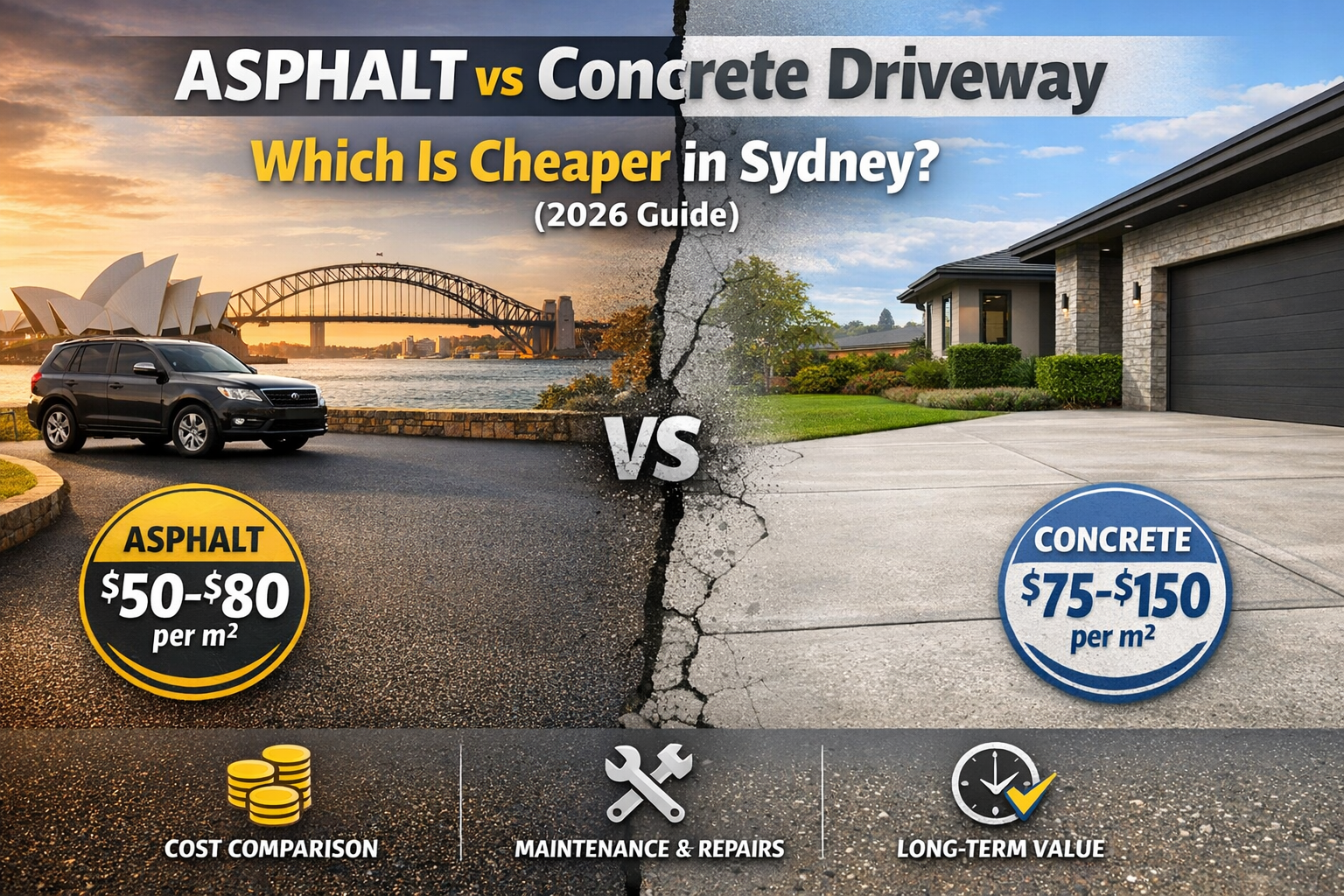
| Asphalt (Standard Hot Mix) | $50 – $80/m² | $4,500 – $7,500 | Most residential |
| Plain Concrete | $75 – $100/m² | $6,500 – $10,000 | Budget-conscious |
| Coloured / Honed Concrete | $120 – $180/m² | $10,000 – $18,000 | Aesthetic upgrade |
| Exposed Aggregate Concrete | $100 – $150/m² | $9,000 – $15,000 | Slope/grip needed |
| Stamped / Decorative Concrete | $135 – $200/m² | $12,000 – $20,000+ | Premium look |
On a standard 60m² driveway typical for a double-car Sydney suburban home asphalt saves you $2,000–$4,000 on installation alone compared to the cheapest concrete option. Against mid-range concrete finishes, that gap widens to $5,000–$10,000. That’s a significant sum before you’ve even turned a wheel on it.
Full Project Cost Comparison
Cost per m² is only part of the picture. Here’s what a complete driveway project looks like including all the components that actually make up your final invoice.
| Cost Component | Asphalt (Sydney) | Plain Concrete (Sydney) | ||
| Base Preparation & Excavation | $800 – $2,500 | $900 – $2,800 | ||
| Materials (60m² driveway) | $1,800 – $3,000 | $2,500 – $5,000 | ||
| Labour (installation) | $1,200 – $2,500 | $2,000 – $4,000 | ||
| Equipment / Machinery | $500 – $1,000 | $600 – $1,200 | ||
| Formwork (concrete only) | Not required | $400 – $1,000 | ||
| Curing / Finishing Costs | Minimal | $200 – $600 | ||
| Council Permit (NSW) | $200 – $500 | $200 – $500 | ||
| TOTAL ESTIMATE (60m²) | $4,500 – $7,500 | $6,800 – $15,100 |
Key Takeaway: For a standard 60m² Sydney driveway, asphalt typically costs $2,000–$7,000 less than plain concrete to install. Against decorative concrete options, the saving exceeds $10,000. Form-work a concrete-only cost adds another $400–$1,000 that asphalt simply doesn’t require.
The Real Cost Over 20 Years
Concrete advocates often argue that while asphalt is cheaper upfront, concrete ‘pays for itself’ over time due to lower maintenance. In Sydney’s specific climate, that argument is far less convincing than it sounds. Here’s why.
| 20-Year Cost Category | Asphalt | Plain Concrete | ||
| Installation (Year 0) | $4,500 – $7,500 | $6,800 – $10,000 | ||
| Seal Coating (every 3–5 yrs) | $800 – $1,500 total | Not required | ||
| Crack Sealing (as needed) | $300 – $800 total | $600 – $2,500 total | ||
| Heat-Damage Repairs (Sydney) | Rare / Minimal | $1,500 – $5,000+ | ||
| Resurfacing (Year 15–20) | $2,000 – $4,500 | Often full replacement | ||
| Full Replacement (if needed) | Not usually needed | $7,000 – $15,000+ | ||
| TOTAL 20-YEAR COST (60m²) | $8,000 – $14,000 | $16,000 – $33,000+ |
This is where the conversation changes. Concrete driveways in Sydney regularly experience cracking due to the city’s extreme summer heat surface temperatures on exposed concrete can exceed 70°C on hot days, causing thermal expansion that cracks the slab from within. Concrete crack repair in Sydney costs $600–$2,500 depending on severity, and a full concrete driveway replacement runs $7,000–$15,000+.
Asphalt, by contrast, expands with the heat instead of cracking against it. The same thermal stress that destroys concrete simply flexes through asphalt without causing structural damage. Over a 20-year period in Sydney, asphalt almost always works out significantly cheaper not just upfront, but in total.
Key Factors for Sydney Homeowners
Cost matters, but it’s not everything. Here’s how the two materials compare across every factor that matters for a Sydney property.
| Factor | Asphalt | Concrete | Winner | ||
| Installation Cost | ✅ $50–$80/m² | ❌ $75–$200/m² | Asphalt | ||
| Installation Time | ✅ 1–2 days | ❌ 3–7 days | Asphalt | ||
| Ready to Use | ✅ 24–72 hours | ❌ 5–7 days minimum | Asphalt | ||
| Lifespan (maintained) | ✅ 20–30 years | ✅ 30–40 years | Concrete | ||
| Sydney Heat Performance | ✅ Flexes — does not crack | ❌ Expands and cracks under extreme heat | Asphalt | ||
| Repair Cost | ✅ Low — patch or resurface easily | ❌ High — concrete is hard to patch well | Asphalt | ||
| Repair Visibility | ⚠️ Patches visible but functional | ❌ Patches rarely match original | Asphalt | ||
| Aesthetic Options | ⚠️ Black only (standard) | ✅ Colour, stamp, aggregate options | Concrete | ||
| Maintenance Required | ⚠️ Seal every 3–5 years | ✅ Minimal beyond cleaning | Concrete | ||
| Long-Term Total Cost | ✅ Lower over 20 years in Sydney climate | ❌ Costly repairs + replacement risk | Asphalt |
Why Sydney’s Climate Strongly Favors Asphalt
This is the factor most comparison articles don’t address properly, and it’s the most important one for any Sydney homeowner making this decision.
Sydney’s climate is characterized by hot, dry summers where driveway surface temperatures regularly reach 60–75°C on exposed pavement well above the ambient air temperature. Combined with cool winters, this creates extreme expansion and contraction cycles that rigid materials like concrete struggle to withstand.
| How ASPHALT handles Sydney’s climate | How CONCRETE handles Sydney’s climate |
| Asphalt is a flexible material — it expands and contracts with temperature changes without cracking or breaking apart. | Concrete is rigid. When it expands in summer heat, it has nowhere to go — the internal pressure causes cracking, particularly at control joints and edges. |
| In extreme heat, asphalt may soften very slightly at the surface, but this is cosmetic and self-correcting. It does not cause structural failure. | Concrete surface temperatures above 60°C cause thermal spelling — small surface pieces breaking off — which damages the slab appearance and structure. |
| Sydney’s UV exposure affects asphalt’s surface colour over time (fading from black to Grey), but a seal coat restores both appearance and protection affordably. | UV exposure breaks down the cement paste in concrete’s surface layer, causing dusting and surface weakness over time. |
| Water drainage is typically better managed with asphalt’s slight surface flexibility, reducing subsurface pressure from moisture. | If concrete cracks and moisture penetrates the slab, the underlying sub-base erodes. Repairs then require full removal — not just patching the surface. |
When Does Concrete Make More Sense Than Asphalt?
We’re asphalt contractors, so you’d expect us to recommend asphalt every time. But that wouldn’t be honest, and it wouldn’t serve you well. There are genuine situations where concrete is the better choice for a Sydney property.
You want a premium aesthetic finish for a high-value property.
Decorative concrete exposed aggregate, coloured, or stamped offers design options that standard asphalt simply can’t match. If kerb appeal and the visual impact of your driveway is a top priority and budget is flexible, decorative concrete delivers a superior finish.
Your driveway is in deep shade with no direct sun exposure.
In permanently shaded areas (e.g., driveways running alongside a north-facing building), concrete’s tendency to crack under heat is largely irrelevant. In these scenarios, concrete’s longer lifespan becomes a genuine advantage.
You’re not planning to stay in the property long-term.
Decorative concrete driveways can add more to a property’s sale value in certain Sydney markets particularly upper North Shore and Inner West where buyers associate concrete with a premium finish.
You need heavy-duty load capacity for constant truck traffic.
For sites with constant heavy vehicle access (trucks over 8 tonne), reinforced concrete at 150–200mm thickness offers superior load-bearing performance that asphalt would need to match at greater depth and cost.
Your local council requires concrete for the crossover section.
Some Sydney councils specify concrete for the section between the street gutter and the property boundary (the crossover). Check with your local council before committing to a full asphalt installation.
Repair Costs
When a driveway fails and all driveways eventually require some repair the cost and complexity of that repair is vastly different for asphalt and concrete. This is where the true long-term cost gap opens up.
| Damage Type | Asphalt Repair Cost | Concrete Repair Cost | Advantage |
| Hairline cracking | $150 – $400 (crack fill) | $300 – $1,200 (routing and filling) | Asphalt |
| Moderate cracking | $400 – $900 (patch + seal) | $1,200 – $3,500 (partial slab removal) | Asphalt |
| Severe cracking / slab failure | $800 – $2,000 (resurface layer) | $5,000 – $12,000 (full replacement) | Asphalt |
| Pothole or depression | $200 – $700 (cut, fill, compact) | $800 – $2,500 (removal and pour) | Asphalt |
| Edge deterioration | $10 – $20 per linear metre | $30 – $80 per linear metre | Asphalt |
| Oil / fuel staining | Dark colour hides most stains | $200 – $600 (etching or overlay) | Asphalt |
| Full resurfacing (end of life) | $20 – $40/m² (overlay existing) | Full demolition required ($40–$80/m²) | Asphalt |
Across every damage type, asphalt repair is cheaper, faster, and less disruptive. The most important distinction is at the end of a driveway’s usable life: asphalt can be resurfaced with a new wearing course laid directly over the existing base, avoiding full excavation and disposal. Concrete cannot be overlaid effectively when a concrete driveway reaches end of life, it requires full demolition, tip fees, and a brand-new pour from the base up.
Which Should You Choose?
Every property is different. Here’s how the choice between asphalt and concrete plays out across common Sydney driveway scenarios.
| Your Situation | Recommended Material | Why |
| Standard suburban home, Hills District or Western Sydney | ✅ Asphalt | Best value, ideal for sun exposure, easy future maintenance |
| Double-car driveway on a budget, under $8,000 | ✅ Asphalt | Concrete simply cannot match asphalt at this price point for quality work |
| New home in Norwest or Bella Vista, practical finish | ✅ Asphalt | Professional appearance, fast turnaround, durable under daily use |
| Luxury property on Upper North Shore, want decorative finish | ✅ Decorative Concrete | Exposed aggregate or coloured concrete suits premium property presentation |
| Steep sloped driveway, need maximum grip | ✅ Coarse Asphalt or Exposed Aggregate | Both materials can provide adequate grip; coarse asphalt is usually cheaper |
| Commercial car park with heavy vehicles daily | ✅ Asphalt (thicker spec) | Faster installation, easier repair, lower disruption to business operations |
| Small courtyard-style driveway, heavily shaded | Either — get quotes for both | Concrete’s longevity advantage applies here; compare quotes for your specific site |
| Long rural driveway on acreage, 500m+ | ✅ Asphalt or Bitumen Seal | Concrete is cost-prohibitive at scale; asphalt or spray seal is the clear choice |
Questions to Ask Your Sydney Contractor
Whether you choose asphalt or concrete, these are the six questions you must ask every contractor before you agree to anything.
1. What base preparation is included in this quote, and what thickness of sub-base will you install? Poor base work is the reason most driveways fail prematurely regardless of whether it’s asphalt or concrete on top.
2. Is removal of my existing surface included in the price? Demolition and disposal costs catch many homeowners off guard. Ask for this to be explicitly missed.
3. What asphalt mix or concrete specification are you using? Reputable contractors should be able to tell you the asphalt grade (e.g., 7mm hot mix) or concrete strength (e.g., N25 at 100mm). Vague answers on this question are a red flag.
4. Will you assess my site in person before pricing? Any quote given without a site inspection is unreliable. Sub-grade conditions, drainage needs, and access constraints cannot be priced from a phone call.
5. What drainage provision is included? Sydney’s summer storm events are intense. If your driveway doesn’t direct water properly, you’ll have pooling, subsurface erosion, and premature surface failure within a few years.
6. What warranty do you offer on the completed work? A confident, professional contractor stands behind their work. Ask specifically what is covered and for how long.
Frequently Asked Questions
Is asphalt cheaper than concrete in Sydney?
Yes! consistently. In Sydney, asphalt costs $50–$80/m² installed versus $75–$100/m² for the most basic plain concrete. On a 60m² driveway, that’s a saving of $2,000–$4,000 on installation alone. Over a 20-year period factoring in repair costs and Sydney’s heat damage to concrete, the gap is even larger.
Does asphalt or concrete add more value to a Sydney property?
Decorative concrete (exposed aggregate, coloured, stamped) can add more perceived value in premium Sydney markets due to its visual appeal. Standard asphalt adds practical value a clean, professional surface that requires no maintenance discussion at sale time. For most mid-range Sydney properties, the difference in resale impact is negligible.
How long does asphalt last compared to concrete in Sydney?
A well-installed asphalt driveway in Sydney lasts 20–30 years with periodic maintenance. A concrete driveway, if it avoids heat cracking, can last 30–40 years. However, Sydney’s climate substantially increases concrete’s cracking risk, meaning the real-world lifespan of concrete in NSW often falls short of its theoretical maximum.
Can I convert my concrete driveway to asphalt?
Yes, in most cases. If the existing concrete is structurally sound (not heaving, sinking, or severely cracked), asphalt can be overlaid directly on top saving demolition and disposal costs. If the concrete is badly deteriorated, it will need to be removed first. New Look Asphalts can assess whether your concrete is suitable for an overlay.
Which is better for a sloped driveway in Sydney?
Both materials can work on slopes. For gradients up to 1-in-5, asphalt with a coarse surface finish provides adequate grip and drains efficiently. For steeper gradients, exposed aggregate concrete or a textured asphalt mix is recommended. A good contractor will specify the right surface texture for your gradient.